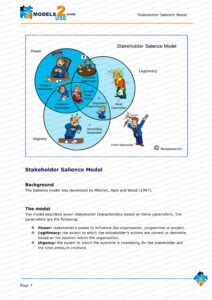
The Stakeholder Salience Model is a framework developed by Mitchell, Agle, and Wood in 1997, designed to help organizations identify and prioritize their stakeholders based on the degree of importance they hold. The model provides a way to assess which stakeholders an organization should focus on by considering three key attributes that determine the salience (importance) of stakeholders:
Three Key Attributes:
- Power: The ability of a stakeholder to influence the organization. This could be through resources, authority, or control over key aspects of the organization.
- Legitimacy: The perceived validity or rightful involvement of the stakeholder in the organization’s decisions or operations. A legitimate stakeholder is someone who has a moral, legal, or socially recognized claim or interest in the organization.
- Urgency: The degree to which the stakeholder’s claim or need requires immediate attention or action from the organization. An urgent claim is one that demands quick resolution or attention.
The Salience Model Diagram:
In the model, stakeholders are categorized based on the combination of these three attributes. This results in a visual representation (often as a Venn diagram) where different types of stakeholders are located depending on the degree of power, legitimacy, and urgency they hold:
- Definitive Stakeholders: These stakeholders have all three attributes—power, legitimacy, and urgency. They are the most important and should be prioritized for engagement.
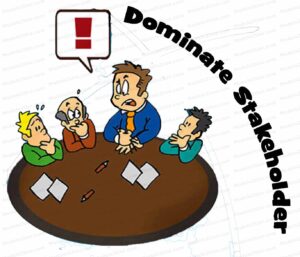
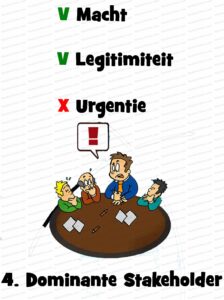
- Dominant Stakeholders: These stakeholders have power and legitimacy but may not necessarily have urgent claims. They are influential and should be treated with importance, but their needs may not require immediate action.
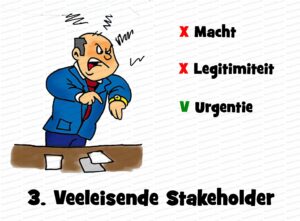
- Dangerous Stakeholders: These stakeholders have power and urgency but may not have legitimacy. They can potentially use their power to force decisions or actions, which can be harmful to the organization.
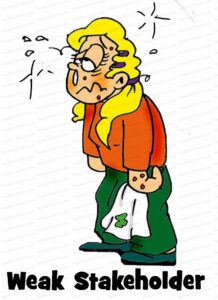
- Dependent Stakeholders: These stakeholders have legitimacy and urgency but lack power. They are important because they have urgent needs, but they may not be able to directly influence the organization unless their needs are met.
- Discretionary Stakeholders: These stakeholders have legitimacy but lack both power and urgency. They are not a priority unless their interests become more urgent or they gain influence.
- Non-Stakeholders: These individuals or groups do not have any of the three attributes and therefore do not need to be considered in the organization’s decision-making processes.
Application
The Stakeholder Salience Model is useful for organizations to map out their stakeholders and determine where to allocate resources and attention. By understanding which stakeholders are the most influential and urgent, companies can make better decisions, engage more effectively, and manage potential conflicts.
In summary, the Stakeholder Salience Model helps organizations prioritize their stakeholders based on the power, legitimacy, and urgency of their needs, ensuring that the most critical stakeholders are addressed first.
Best regards,
Plume Perdue
This product includes the following components, delivered via link/email upon purchase:
- Cartoon depiction of the model (JPG – 2 to 5 MB)
- Plume Perdue’s “true opinion” with an explanation of the model, provided in PDF format
- Separate images of characters or model elements, ideal for use in presentations (JPG, transparent background)
Cherry-pick and spice it up with your own flavor!

Het Stakeholder Salience Model is een model ontwikkeld door Mitchell, Agle en Wood in 1997, ontworpen om organisaties te helpen bij het identificeren en prioriteren van hun stakeholders op basis van de mate van belangrijkheid die zij hebben. Het model biedt een manier om te beoordelen op welke stakeholders een organisatie zich moet concentreren, door drie belangrijke eigenschappen te overwegen die de salience (belangrijkheid) van stakeholders bepalen:
Drie Belangrijke Attributen:
- Macht (Power): Het vermogen van een stakeholder om invloed uit te oefenen op de organisatie. Dit kan door middelen, autoriteit of controle over belangrijke aspecten van de organisatie.
- Legitimiteit (Legitimacy): De waargenomen geldigheid of rechtmatigheid van de betrokkenheid van de stakeholder in de beslissingen of activiteiten van de organisatie. Een legitieme stakeholder is iemand die een morele, juridische of sociaal erkende claim of belang heeft in de organisatie.
- Urgentie (Urgency): De mate waarin de claim of behoefte van de stakeholder onmiddellijke aandacht of actie van de organisatie vereist. Een urgente claim is een die snel opgelost of behandeld moet worden.
Het Salience Model Diagram:
In het model worden stakeholders gecategoriseerd op basis van de combinatie van deze drie eigenschappen. Dit resulteert in een visuele representatie (vaak als een Venn-diagram) waarin verschillende soorten stakeholders worden geplaatst afhankelijk van de mate van macht, legitimiteit en urgentie die zij bezitten:
- Definitieve Stakeholders: Deze stakeholders hebben alle drie de attributen — macht, legitimiteit en urgentie. Ze zijn het belangrijkst en moeten de hoogste prioriteit krijgen voor betrokkenheid.
- Dominante Stakeholders: Deze stakeholders hebben macht en legitimiteit, maar misschien niet noodzakelijkerwijs urgente claims. Ze zijn invloedrijk en moeten belangrijk worden genomen, maar hun behoeften vereisen mogelijk geen onmiddellijke actie.
- Gevaarlijke Stakeholders: Deze stakeholders hebben macht en urgentie, maar hebben misschien geen legitimiteit. Ze kunnen hun macht gebruiken om beslissingen of acties af te dwingen, wat schadelijk kan zijn voor de organisatie.
- Afhankelijke Stakeholders: Deze stakeholders hebben legitimiteit en urgentie, maar geen macht. Ze zijn belangrijk omdat ze dringende behoeften hebben, maar kunnen de organisatie mogelijk niet direct beïnvloeden, tenzij hun behoeften worden vervuld.
- Discretionaire Stakeholders: Deze stakeholders hebben legitimiteit, maar missen zowel macht als urgentie. Ze zijn geen prioriteit, tenzij hun belangen urgenter worden of ze invloed verkrijgen.
- Niet-Stakeholders: Deze individuen of groepen hebben geen van de drie attributen en hoeven daarom niet in de besluitvormingsprocessen van de organisatie te worden meegenomen.
Toepassing:
Het Stakeholder Salience Model is nuttig voor organisaties om hun stakeholders in kaart te brengen en te bepalen waar ze middelen en aandacht aan moeten besteden. Door te begrijpen welke stakeholders de meest invloedrijke en urgente behoeften hebben, kan een organisatie betere beslissingen nemen, effectiever communiceren en mogelijke conflicten beheersen.
Samenvattend helpt het Stakeholder Salience Model organisaties om hun stakeholders te prioriteren op basis van de macht, legitimiteit en urgentie van hun behoeften, zodat de meest kritieke stakeholders als eerste worden aangesproken.
Bij vragen gewoon ff mailen of bellen
Grtz Plume Perdue
Dit product bevat de volgende onderdelen die worden meegeleverd in de link/email bij aankoop:
- Cartoon van het model. (JPG – 2 tot 5 MB)
- De ‘waarmening’ van Plume Perdue met een toelichting op het model. Aangeleverd in Pdf-formaat
- Losse afbeeldingen van de karakters of model onderdelen. Uitstekend te gebruiken bij bijvoorbeeld presentaties (JPG, transparant)
Cherry Pick en lardeer het met je eigen sausje …











![MDL449 - EN - Stakeholder Salience Model [800x600] - WM](https://models2use.com/wp-content/uploads/2025/01/MDL449-EN-Stakeholder-Salience-Model-800x600-WM-300x225.jpg)
![MDL449 - NE - Stakeholder Salience Model [800x600] - WM](https://models2use.com/wp-content/uploads/2025/01/MDL449-NE-Stakeholder-Salience-Model-800x600-WM-300x225.jpg)