Origin
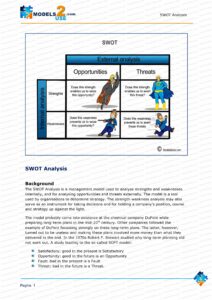
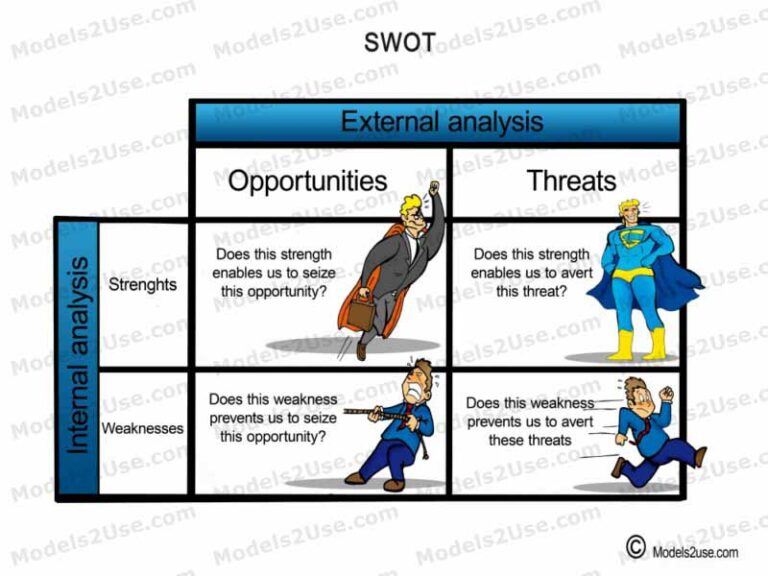
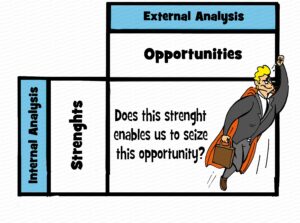
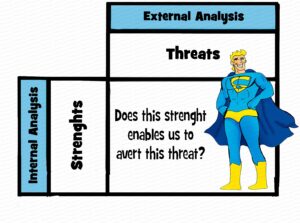
The SWOT Analysis is a business model that analyzes internal strengths and weaknesses, as well as external opportunities and threats. The model serves as a tool to help organizations determine their strategy. The strength-weakness analysis can also serve as a means for decision-making and to review the position, direction, and strategy of a company.
The model likely originated at the chemical company DuPont when they were creating long-term plans in the mid-20th century. Other companies, following DuPont, also began focusing on these long-term plans. However, the plans proved to be little more than theoretical and were often more costly to create than the benefits they provided. In the 1970s, Robert F. Stewart conducted research to understand why long-term planning wasn’t effective. This led to the creation of the SOFT model:
- Satisfactory (sufficient): good in the present is sufficient
- Opportunity (chance): good in the future is an opportunity
- Fault (error): bad in the present is a fault
- Threat: bad in the future is a threat
Later, the element “Fault” was translated into “Weaknesses.” A bit of rearranging, and the acronym SWOT was born.
The model
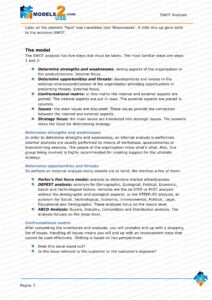
The SWOT analysis consists of five steps. The most well-known are steps 1 and 2:
- Identify strengths and weaknesses (Strengths & Weaknesses): Strong aspects of the organization or product/service. Internally focused.
- Identify opportunities and threats (Opportunities & Threats): Developments and events in the external environment/context of the organization that present opportunities or threats. Externally focused.
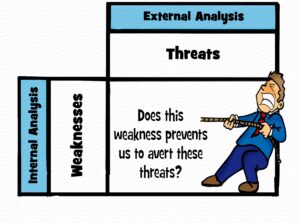
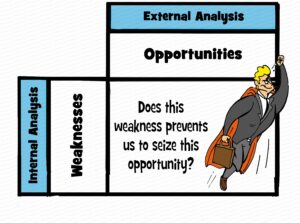
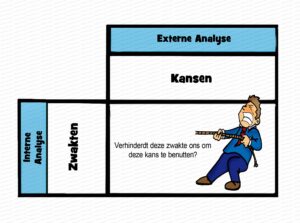
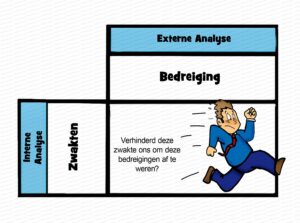
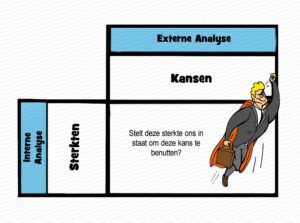
- Confrontation matrix: In this matrix, internal and external aspects are placed against each other. Internal aspects are listed in rows, and external aspects are listed in columns.
- Issues: The key issues are addressed. These issues bridge the internal and external aspects.
- Strategic focus: The most important issues are translated into strategic questions. The answers to these questions provide input for strategy development.
If you have any questions, feel free to email or call.
Best regards,
Plume Perdue
This product includes the following components, delivered via link/email upon purchase:
- Cartoon depiction of the model (JPG – 2 to 5 MB)
- Plume Perdue’s “true opinion” with an explanation of the model, provided in PDF format
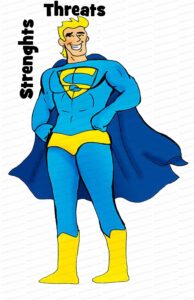
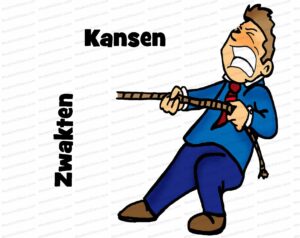
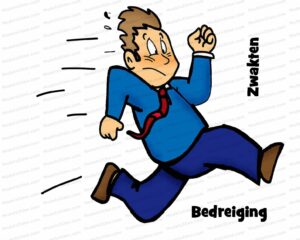
- Separate images of characters or model elements, ideal for use in presentations (JPG, transparent background)
Cherry-pick and spice it up with your own flavor!

Oorsprong
De SWOT Analyse is een bedrijfskundig model dat intern de sterktes en zwaktes en extern de kansen en bedreigingen analyseert. Het model dient als hulpmiddel om organisaties te helpen hun strategie te bepalen. De sterkte-zwakte analyse kan ook als middel dienen om beslissingen te nemen en om de positie, de koers en de strategie van een bedrijf tegen het licht te houden.
Het model heeft waarschijnlijk zijn levenslicht gezien bij het chemiebedrijf DuPont bij het maken van lange termijn plannen midden 20e eeuw. Andere bedrijven zijn in navolging van DuPont zich eveneens sterk gaan richten op deze lange termijn plannen. De plannen bleken echter weinig bruikbaar en het maken kostte meer dan wat het opleverde. In de jaren 70 van de vorige eeuw heeft Robert F. Stewart een onderzoek uitgevoerd waarom lange termijn planning niet werkte. Dit onderzoek leidde tot het SOFT model:
- Satisfactory (voldoende): goed in het heden is Voldoende
- Opportunity (kans): goed in de toekomst is een Kans
- Fault (fout): slecht in het heden is een Fout
- Threat (bedreiging): slecht in de toekomst is een Bedreiging
Later werd het element ‘Fout’ vertaald naar ‘Zwakte/Weaknesses’. Een beetje husselen en het acroniem SWOT was een feit.
Het model
De SWOT analyse kent 5 stappen die worden doorlopen. De meest bekende zijn stap 1 en 2:
- Vaststellen sterktes en zwaktes (Strenghts & Weaknesses): sterke aspecten van de organisatie of het product/dienst. Intern gericht
- Vaststellen kansen en bedreigingen (Opportunities & Threats): ontwikkelingen en gebeurtenissen in de externe omgeving/context van de organisatie die kansen bieden of bedreigingen vormen. Extern gericht
- Confrontatiematrix: in deze matrix worden de interne en externe aspecten tegenover elkaar uitgezet. De interne aspecten in de rijen. De externe aspecten in de kolommen
- Kwesties (Issues): de belangrijkste kwesties worden behandeld. De kwesties leggen de verbinding tussen de interne en externe aspecten
- Strategiefocus: de belangrijkste kwesties worden vertaald naar strategische vraagstukken. De antwoorden hierop zijn input voor de strategiebepaling
Dit product bevat de volgende onderdelen die worden meegeleverd in de link/email bij aankoop:
- Cartoon van het model. (JPG – 2 tot 5 MB)
- De ‘waarmening’ van Plume Perdue met een toelichting op het model. Aangeleverd in Pdf-formaat
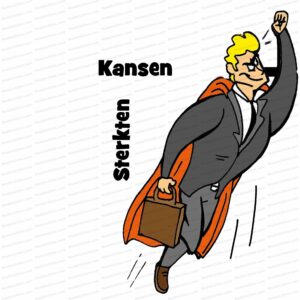
- Losse afbeeldingen van de karakters of model onderdelen. Uitstekend te gebruiken bij bijvoorbeeld presentaties (JPG, transparant)
Cherry Pick en lardeer het met je eigen sausje …








![MDL059 - EN - SWOT [800x600] - WM](https://models2use.com/wp-content/uploads/2025/01/MDL059-EN-SWOT-800x600-WM-300x225.jpg)
![MDL059 - NE - SWOT [800x600] - WM](https://models2use.com/wp-content/uploads/2025/01/MDL059-NE-SWOT-800x600-WM-300x225.jpg)